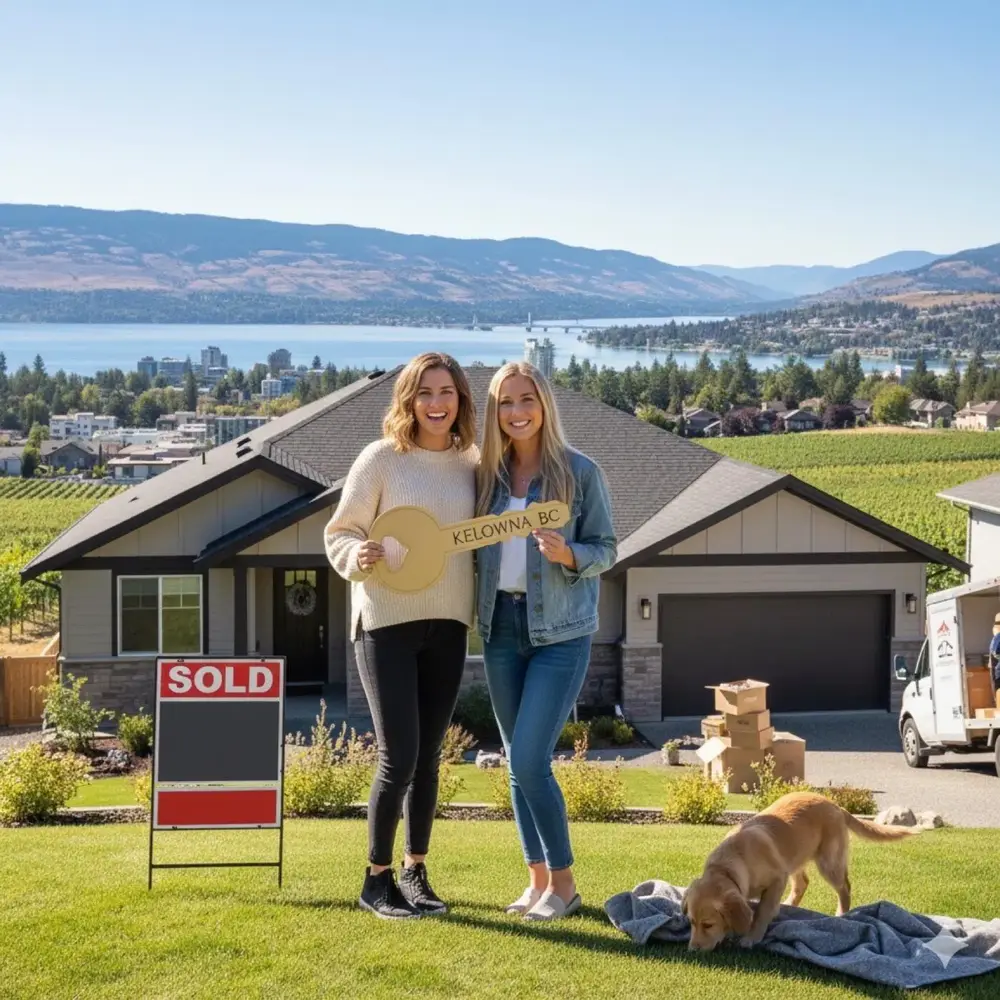
First-Time Home Buyer's Guide to the Okanagan
Everything you need to know about buying your first home in Kelowna, West Kelowna, or Lake Country—from BC programs to neighbourhood picks to the step-by-step process.
$35K
RRSP HBP Limit
5%
Min Down Payment
$8K
PTT Savings
5+
BC Programs

Giuseppe Gaspari
REALTOR® | Okanagan Real Estate Specialist
Helping families find their perfect Okanagan home since 2018
Last updated: February 2026
Why Buy Your First Home in the Okanagan?
I get it—buying your first home feels overwhelming. The prices, the paperwork, the fear of making a mistake with the biggest purchase of your life. I've helped dozens of first-time buyers navigate this process, and I promise: it's more manageable than it seems.
The Okanagan is one of the best places in Canada to put down roots. Four seasons of outdoor activities. A growing job market. A lifestyle that people pay a premium to access. Yes, prices here are higher than the Canadian average—but they're still far below Vancouver, and the quality of life is hard to match.
This guide covers everything a first-time buyer needs to know about the Kelowna real estate market: the programs that can help you, the neighbourhoods where you'll get the best value, the true costs beyond the purchase price, and the mistakes to avoid.
Let's get you into your first home.
What Can You Actually Afford?
Before you start browsing listings, you need to know your numbers. Not what you dream of—what you can actually qualify for and comfortably afford.
Quick Affordability Guide (2026)
*Estimates assume 10% down, current interest rates, and minimal other debts. Actual approval depends on credit score, debt ratios, and lender criteria.
Down Payment Requirements
- Under $500,000: Minimum 5% down
- $500,000–$999,999: 5% on first $500K, 10% on remainder
- $1,000,000+: Minimum 20% down
Putting down less than 20% means you'll pay CMHC mortgage insurance—typically 2.8-4% of the mortgage amount, added to your loan. It's not ideal, but it's how most first-time buyers get into the market.
First-Time Buyer Programs (Use Every One You Qualify For)
There are several federal and provincial programs designed to help first-time buyers. Many people don't use all the programs they qualify for, leaving thousands of dollars on the table.
BC First-Time Home Buyer PTT Exemption
Save up to $8,000 on Property Transfer Tax
Eligibility: Homes up to $500K (partial to $525K), BC resident 1+ year, never owned property worldwide
Learn more →Home Buyers' Plan (HBP)
Withdraw up to $35,000 from RRSP tax-free
Eligibility: First-time buyer, funds in RRSP 90+ days, must repay over 15 years
Learn more →First-Time Home Buyer Incentive (FTHBI)
5-10% shared equity loan from government
Eligibility: Household income under $120K (or $150K in high-cost areas), mortgage must be less than 4x income
Learn more →BC Home Owner Mortgage and Equity Partnership
Matching loan up to $37,500 (interest-free for 5 years)
Eligibility: Income under $150K, purchase price under $750K, must be principal residence
Learn more →First Home Savings Account (FHSA)
$8,000/year tax-deductible, $40,000 lifetime, tax-free withdrawal
Eligibility: Canadian resident, 18-71, first-time buyer, can combine with HBP
Learn more →The Property Transfer Tax Exemption (Don't Miss This)
Property Transfer Tax (PTT) is one of BC's hidden costs—1% on the first $200K, 2% on $200K–$2M. On a $500,000 home, that's $8,000. As a first-time buyer, you may be completely exempt.
Full Exemption Requirements:
- Purchase price $500,000 or less
- Canadian citizen or permanent resident
- Lived in BC for 12 months before purchase (or filed 2 BC tax returns in last 6 years)
- Never owned property anywhere in the world (your name on any title disqualifies you)
- Property is 0.5 hectares or smaller
- You'll live there as your principal residence
Partial exemption: Homes between $500,000 and $525,000 get a proportional exemption. Above $525,000, you pay full PTT.
Newly built home exemption: For new construction, the threshold is higher—up to $750,000 for a full exemption, with partial exemption to $800,000.
Real Impact Example
Buying a $495,000 condo in Downtown Kelowna as a first-time buyer:
Without exemption: $7,900 PTT
With exemption: $0
Your savings: $7,900 that stays in your pocket
The RRSP Home Buyers' Plan: Use Your Retirement Savings
The Home Buyers' Plan (HBP) lets you withdraw up to $35,000 from your RRSP tax-free to buy your first home. If you're buying with a partner, that's $70,000 combined.
How It Works:
- Funds must be in your RRSP for at least 90 days before withdrawal
- You withdraw up to $35,000 without paying withholding tax
- You use it for your down payment
- Starting in year 2, you repay 1/15 of the amount back to your RRSP annually
- If you miss a repayment, that amount becomes taxable income
Pro tip: If you know you're buying in a few years, maximize your RRSP contributions now. You get the tax deduction, then use HBP for your down payment. The First Home Savings Account (FHSA) is even better if you have time—it combines RRSP-style deductions with TFSA-style tax-free growth and withdrawal.
Need help planning your down payment strategy?
I can connect you with mortgage brokers who specialize in helping first-time buyers maximize these programs.

Understanding your financing options is the first step to homeownership
Best Neighbourhoods for First-Time Buyers
Not all Okanagan neighbourhoods are created equal for first-time buyers. Here's where to look based on budget and lifestyle— from someone who grew up here and knows every corner.
Downtown Kelowna (Condos)
Walkable, close to beach and restaurants, no car needed
Smaller units, strata fees, parking can be extra
Young professionals, singles, couples without kids
University District (Condos/Townhomes)
Near UBCO, newer builds, good rental potential
Student-heavy area, further from downtown
Investors, students, those working at UBCO
Rutland (Townhomes/Houses)
Most affordable detached homes, improving rapidly
Reputation issues (mostly outdated), further from lake
Families wanting a yard, buyers priced out of other areas
Glenmore (Townhomes)
Suburban feel, good schools, near airport/UBCO
Less walkable, need a car
Families, commuters to airport corridor
West Kelowna (Various)
More space for money, wine country lifestyle
Bridge commute to Kelowna, less urban amenities
Families, wine lovers, those working on the west side
Lake Country (Various)
Family-friendly, outdoor lifestyle, newer developments
20-30 min to downtown Kelowna
Outdoor families, those wanting community feel
Vernon (All Types)
15-20% cheaper than Kelowna, ski access, less crowded
45 min to Kelowna, smaller city amenities
Ski enthusiasts, budget-conscious buyers, remote workers
Want detailed guides on each area?
The Home Buying Process: Step by Step
Get Pre-Approved for a Mortgage
Talk to a mortgage broker or bank. You'll provide income verification, ID, and credit check. Pre-approval tells you exactly what you can afford and locks in a rate for 90-120 days.
Find a REALTOR® Who Knows the Area
Look for someone who lives here, knows the neighbourhoods, and will be honest with you—not just someone trying to close a deal. Interview a few before committing.
Define Your Must-Haves and Nice-to-Haves
Be realistic. First homes involve trade-offs. Know what you can't compromise on (location, bedrooms, parking) versus what you can live without initially.
Start Viewing Properties
Your agent will set up showings. Expect to see 5-15 homes before finding the right one. Take notes and photos. Don't rush—but don't wait forever either.
Make an Offer
Your agent will help you craft a competitive offer based on comparable sales, market conditions, and seller motivation. You'll include conditions for financing and inspection.
Negotiate and Reach Acceptance
Sellers may counter-offer. There may be back-and-forth. Once both parties sign, you have a conditional contract.
Remove Subjects
Complete your home inspection, finalize financing, and review any condo/strata documents. Once conditions are satisfied, you remove subjects—the contract is now firm.
Prepare for Closing
Work with your lawyer or notary to complete paperwork. Arrange insurance. Do a final walkthrough. Transfer funds for closing costs and down payment.
Get the Keys!
On completion day, your lawyer registers the title, funds are transferred, and you pick up your keys. You're officially a homeowner.
The moment every first-time buyer works toward—getting your keys
The True Costs of Homeownership
Your mortgage payment is just the beginning. Here's what first-time buyers often underestimate.
Upfront Costs
- Down payment5-20% of price
- Property Transfer Tax$0–$8,000+
- Legal fees$1,000–$1,500
- Home inspection$400–$600
- Appraisal fee$300–$500
- Title insurance$200–$400
- Moving costs$500–$2,000+
Monthly Costs
- Mortgage paymentVaries
- Property taxes$200–$500/mo
- Home insurance$100–$200/mo
- Strata fees (condos)$200–$600/mo
- Utilities$150–$350/mo
- Maintenance reserve$200–$400/mo
The Hidden Cost
Budget 1-3% of your home's value annually for maintenance and repairs. On a $500,000 home, that's $5,000-$15,000 per year. Things break—furnaces die, roofs leak, appliances fail. Have an emergency fund.
Common First-Time Buyer Mistakes
Not getting pre-approved first
You waste time looking at homes you can't afford, and sellers don't take you seriously.
Skipping the home inspection
A $500 inspection can save you from a $50,000 foundation problem. Never skip it.
Maxing out your budget
Just because you qualify for $600K doesn't mean you should spend $600K. Leave room for life.
Ignoring strata documents
Strata minutes can reveal upcoming special levies, building issues, or restrictive rules. Read them.
Falling in love before the inspection
Stay objective until all conditions are satisfied. Emotional attachment clouds judgment.
Not factoring in all costs
Strata fees, property taxes, insurance, utilities—they add up fast beyond your mortgage.
Buying in a neighbourhood you don't know
Visit at different times of day. Talk to neighbors. Drive the commute. Know what you're buying into.
Making major purchases before closing
That new car or furniture could change your debt ratios and kill your mortgage approval. Wait.
Condo vs. Townhome vs. House: Which Is Right for You?
For most first-time buyers in Kelowna, the choice comes down to budget and lifestyle. Here's the honest breakdown.
Condo ($350K–$600K)
Singles, couples, investors, low-maintenance lifestyle
Strata fees ($200-$600/mo), rules on pets/rentals, less privacy
Townhome ($500K–$800K)
Young families, couples wanting more space, those who want a yard
Still have strata, shared walls, smaller lots than detached
Detached House ($700K–$1.2M+)
Families, those wanting full control, long-term owners
Higher price, all maintenance is yours, larger yard work
My honest advice: For most first-time buyers in Kelowna, a condo or townhome is the realistic starting point. Get into the market, build equity, and upgrade later. Waiting for the "perfect" detached home often means waiting forever.
First-Time Buyer Timeline
6-12 Months Before
- Check your credit score and fix any issues
- Start saving aggressively—down payment and closing costs
- Open an FHSA if you haven't already
- Research neighbourhoods online
3-6 Months Before
- Get mortgage pre-approval
- Interview and select a REALTOR®
- Define your must-haves vs. nice-to-haves
- Start viewing open houses casually
1-3 Months Before
- Active house hunting with your agent
- View 5-15+ properties
- Make offers (you may need several attempts)
- Get an offer accepted
30-60 Days Before Closing
- Complete home inspection
- Finalize mortgage with lender
- Review strata docs (for condos/townhomes)
- Remove subjects
- Work with lawyer/notary on paperwork
Closing Week
- Final walkthrough
- Transfer funds
- Sign documents with lawyer
- Get your keys!
Frequently Asked Questions
How much do I need for a down payment to buy a home in Kelowna?
In Canada, the minimum down payment is 5% for homes under $500,000, and 10% on the portion between $500,000 and $1 million. For a $600,000 Kelowna condo, you'd need at least $35,000 down (5% of $500K + 10% of $100K). However, putting down less than 20% means paying CMHC mortgage insurance, which adds to your costs.
What is the Property Transfer Tax exemption for first-time buyers in BC?
First-time home buyers in BC can get a full exemption from Property Transfer Tax on homes up to $500,000, and a partial exemption on homes between $500,000 and $525,000. To qualify, you must be a Canadian citizen or permanent resident, have lived in BC for at least one year, never owned property anywhere in the world, and intend to live in the home as your principal residence.
What is the First-Time Home Buyer Incentive (FTHBI)?
The FTHBI is a federal program where the government provides 5% (existing homes) or 10% (new builds) of the purchase price as a shared equity loan. You don't make payments on it, but you repay the same percentage of your home's value when you sell or after 25 years. It reduces your monthly mortgage payments but means sharing appreciation with the government.
Can I use my RRSP to buy a first home in Kelowna?
Yes, through the Home Buyers' Plan (HBP). You can withdraw up to $35,000 from your RRSP ($70,000 for couples) tax-free for a down payment. You must repay it to your RRSP over 15 years, starting the second year after withdrawal. It's essentially an interest-free loan from yourself.
What are the most affordable neighbourhoods for first-time buyers in Kelowna?
For condos, Downtown Kelowna and the University District offer options in the $350,000-$500,000 range. For townhomes, look at Rutland, Glenmore, or Springfield ($500,000-$700,000). Detached homes for first-time buyers are increasingly found in Rutland or require looking outside Kelowna to West Kelowna, Lake Country, or Vernon for better value.
How much income do I need to buy a home in Kelowna in 2026?
As a rough guideline, lenders allow mortgage payments of about 32% of gross income. For a $500,000 condo with 10% down, you'd need roughly $100,000-$120,000 household income. For a $700,000 townhome, you'd need $140,000-$160,000. These numbers vary based on interest rates, other debts, and down payment size.
What are closing costs for first-time buyers in BC?
Budget 1.5-4% of the purchase price for closing costs. This includes legal fees ($1,000-$1,500), home inspection ($400-$600), appraisal ($300-$500), title insurance ($200-$400), and Property Transfer Tax (which first-time buyers may be exempt from on homes under $500K). On a $500,000 home, expect $7,500-$20,000 in closing costs.
Should I get pre-approved for a mortgage before looking at homes?
Absolutely. Pre-approval tells you exactly how much you can afford, locks in an interest rate for 90-120 days, and shows sellers you're a serious buyer. In competitive situations, a pre-approved buyer often wins over one who hasn't done their homework. Talk to a mortgage broker or your bank before you start shopping.
What is the BC Home Owner Mortgage and Equity Partnership?
This provincial program provides a 25-year loan (interest-free for the first 5 years) matching your down payment up to 5% of the purchase price, to a maximum of $37,500. Combined with your savings, it can help you reach a 10% down payment. Income limits and purchase price caps apply—check BC Housing for current eligibility.
How long does it take to buy a home in Kelowna as a first-time buyer?
From pre-approval to keys, expect 2-6 months. The pre-approval process takes 1-2 weeks. Active house hunting varies widely—some buyers find the right home in a week, others take months. Once you have an accepted offer, closing typically takes 30-60 days for financing, inspections, and legal work.
Ready to Buy Your First Okanagan Home?
I've helped dozens of first-time buyers navigate this process. I'll explain every step, answer every question, and make sure you find the right home for your budget and lifestyle.